LET’S PREPARE THE BIGA
The first thing to do to make our pizzas in pala alla romana is to prepare a nice classic biga.
- Place 360 g of water in a box along with 8 g of fresh brewer’s yeast and 800 g of flour.
- Start mixing with the fork, then with your hands and massage until it has reached the right consistency and you no longer feel dry flour between your fingers.
- Once ready, transfer it to a 6-liter container, close it with its lid and let it ferment for 18 hours at 18°C.

KNEADING
As soon as your biga reaches the right degree of fermentation gaining a pleasant but pungent alcoholic aromatic note and its volume is slightly increased, you can proceed with the kneading.
- Insert the biga as it is in the mixer tank along with 200 g of type 1 flour, 10 g of yeast, 18 g of malt and the first 150-170 g of the 440 of water needed.
- Inizia a impastare a bassa velocità e quando l’impasto inizia ad avere una buona consistenza, aggiungi altri 100 g di acqua.
- As soon as the dough catches rope, add another drop of water along with 25 g of salt
- Continue to knead by increasing the speed, until all the remaining water is finished and naturally adding little at a time.
- When the dough is perfectly formed, insert 30 g of extra virgin olive oil and wait for it to be completely incorporated.
PUNTATA
- Once the dough is closed, take it out of the tub, transfer it to the counter and give it a nice round of folds.
- Then store it in the same container in which you fermented the biga and wait for it to double.

CUT AND SHAPE
- After the time, pour the dough on the counter, divide it into 300 g pieces
- Then move each piece on a nice bed of re-milled semolina, make a bundle, picking up each flap towards the center and folding the dough on itself.
Super important: don’t oversqueeze the loaves, they have to stay nice and light and you don’t have to scramble them. - Then, let the loaves rise in a cassette or in individual containers at room temperature until they double (for about 2 hours).

DRAFTING AND COOKING
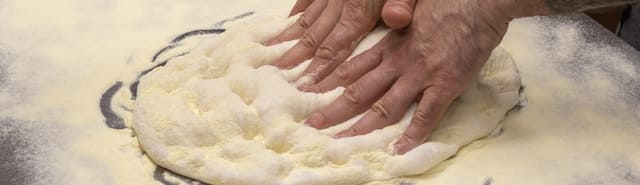
- After the time, turn each dough over a nice bed of abundant semolina and spread it out by pressing very decisively.
- Lay the dough spread on the appropriate shovel, water it with plenty of EVO oil and arrange the corners.

- At this grease go in the oven with the plate at 290°C and the chamber at 260 for about 5-6 minutes to perform the pre-cooking.
You can also bake it in the home oven. Heat a refractory stone well by setting the oven to maximum power, even for an hour or an hour and a half. If you give it a nice boost on the bottom, the product also comes well in the home oven. - Then take the oven, let them cool so you can store them for 3-4 days in the fridge or for a week in the freezer after tucked them into the classic frost bags.

To warm up
- Take one of the shovels stored in the refrigerator or freezer (in this case let it defrost), divide it in two and stuff it as you like. For example with plenty of gorgonzola, a few slices of mortadella and toasted pistachios.
- Place one of our stainless steel grills in the preheated oven at 220°C and regenerate your stuffed shovel for 4 or 5 minutes.

CONCLUDING
The important percentage of biga along with the abundant amount of yeast will allow the dough to open well and the crust to have a friability that it has never experienced.
I’ll open a small parenthesis: I don’t particularly like pizza on a shovel seasoned on the surface. The shovel must be crispy both above and below, so it must be broken and stuffed inside.
The nice thing about this product is that with rigenero you can stuff it in any way you can think of, without any limit.
If you have any questions or curiosities to deepen on the recipe just read, write me a message below the video tutorial I shot for this splendid pizza in pala alla romana:
…And now knead, enjoy and taste!
Rudy